Friday, July 1, 2016

Solo Hale: Lijiashan, Shanxi, China 2016

   Lijiashan, Shanxi, China


Lijiashan is a remote cave-dwelling village on a mountain about 20 minutes outside of Qikou. There is nothing commercial about this place and luckily hardly any tourists. The occasional rental jeep drove up and a handful of Chinese tourists got out, walked around and went back to Qikou. I first walked up here the day after arriving in Qikou. Luckily the last 10kms uphill was an easy ride in a car with a hospitable local man who stopped and offered me a ride. It was early morning, only 8 am when I arrived, and the walking that I did do made me really ready to eat breakfast. There were no restaurants or shops or anything up here, but a lady came out of her home and greeted me. I asked her about breakfast possibilities, and she immediately invited me to eat. Breakfast was a fabulous Chinese fare, overlooking the spectacular yellow loess cliffs that the yao dongs were carved out of on the other side of a gorge from her high, courtyard verandah. She served me zhou (rice porridge), pickled cucumber salad and a boiled egg and some fa gao (steamed slightly sweet cake-like bread ).
   Yao dong owner, Lijiashan

Yao dong where I stayed on Lijiangshan...$12(Can.) a night including 3 meals..


After wandering around landscape which I considered even more spectacular than Qikou, I was wide-eyed with wonder at this ancient place. I felt as though I were in a fairytale and that little hobbit like people might emerge any minute from the caves of varying shapes and sizes which blended so naturally into the landscape.
There was no doubt in my mind..I would return the next day to stay here, and explore this magical village and experience the varying lights of the day from morning to night.


    Architecture, Lijiashan
   Elderly woman selling Chinese red dates, Lijiashan

   Lijiashan Village

                  The 'protective' roof ornaments were impressive
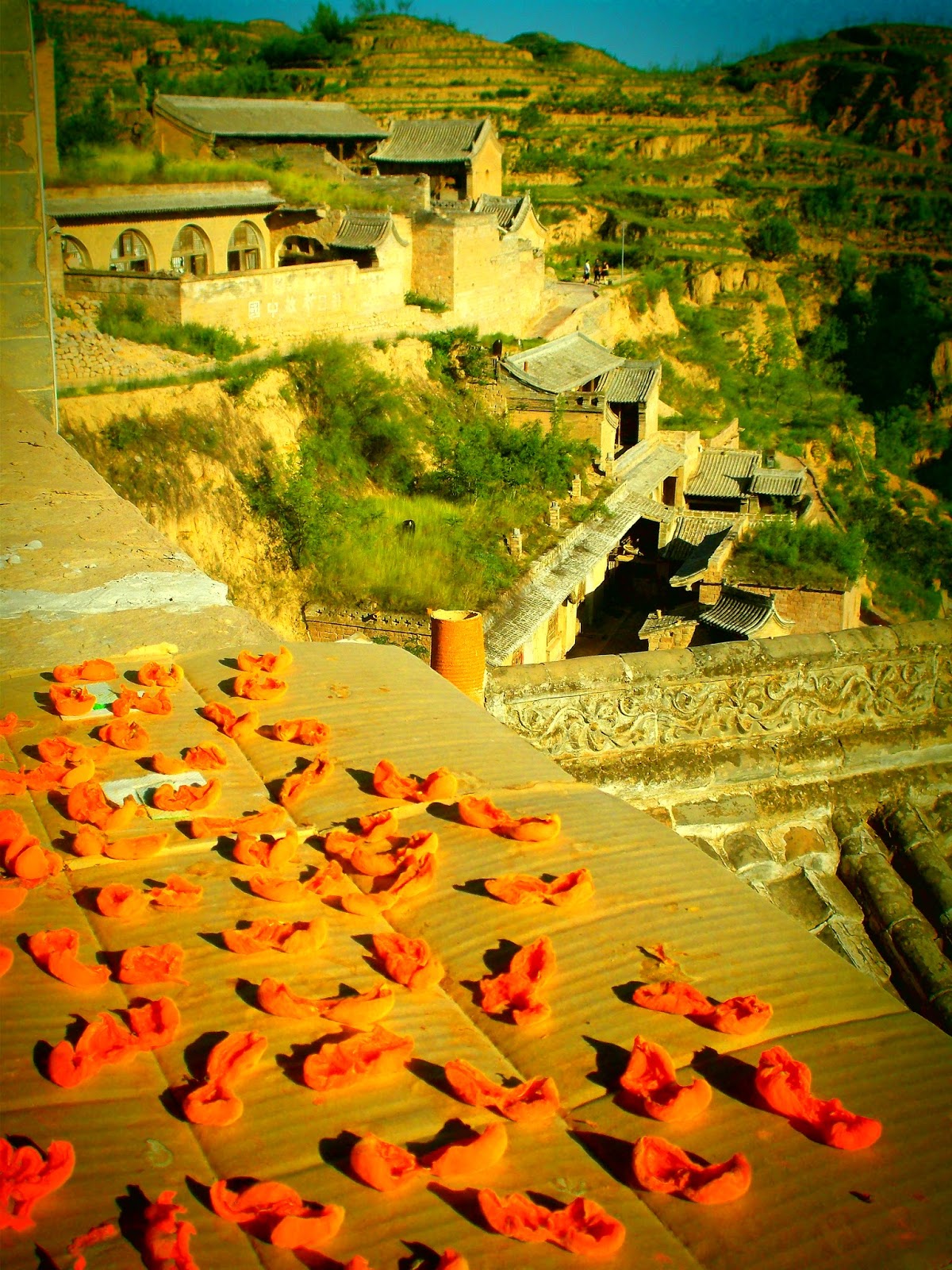
                 Lots of apricot trees here...

                  Village child, Lijiashan

   Evening sun, Lijiashan

Typical hearth, Lijiashan


The lone entrepreneurs in the village..with a freezer full of cold drinks and plenty of smiles!
There were so many secret paths and passageways leading to yet more and more cave homes and mountain vistas


                  Happy explorer!


Wednesday, June 29, 2016

Solo Traveller - Qikou, Shanxi, China 2016


                                                                             Hei Long Temple, Qikou

The hot summer and grouchy Beijingers drove me out of the city in search of  fresh air, nature and traditional Chinese culture to a hidden gem in Shanxi province.
Qikou is an small ancient town on the banks of the Huang he (Yellow River).
It was once a major port during the Ming and Qing dynasties, where hundreds of boats berthed everyday  carrying goods from north China such as cereals, oils, salt, furs, medicines, etc., to be traded or transported to other places.
Today it is know for it's cave dwellings built into the hillsides, where the local people live.
It was a bit of journey getting there..about 6 hours from Pingyao by 3 separate buses, but the people were so friendly that even the ramshackle buses were a source of fun.
The small buses were crammed with people trying to hang on as we sped around the bends; old men chain smoked despite the toddlers on board, and an old stooped-over woman who shared half of my seat, threw up occasionally. A happy group of high school students piled into the little bus too and one who struggled with a wee bit of English pushed her excited way towards me and soon they were all hanging over me and wanting to take pictures. With my broken Chinese we managed to get to know a bit about each other and made the time fly by in a rather festive way.


From the moment I arrived in Qikou, I was like a movie star.. Everywhere I went people shouted "Hello!" and stared and smiled and wanted to take my photo. I never did see any other 'foreigners' during my time there, so I got all the attention from the curious locals. 
There are mostly elderly people living in Qikou and many of them  lined the main street as I walked over it's old cobbled path. One old lady sprang up, took my hand in hers and guided me to a homestay..how convenient is that?
I was thrilled when after turning down a small alleyway, still holding my hand firmly, she opened a set of old weathered doors to reveal a family's "yao dong" (cave dwellings) where I would spend the next few nights. There were plants outside everywhere; huge sunflowers and an aloe plant as big as myself, along with many cactus and all kinds of other plants and flowers, as if there to greet me in the sunny, cheerful courtyard of their home.
A kind elderly man and his wife emerged offering greetings from a yao dong gorgeously decorated with calibash gourds of all sizes and red Chinese dates which hung in woven clusters here and there.

The Yao Dong I slept in 


 When the owner opened the door to the yao dong, i didn't know what i would find. I was thrilled to be staying in one of these dwellings finally, and was so happy to see how pleasant it was inside. The arced cave-like walls were painted white, there was a table and several stools around it, there was a tv and there was even a shower room. Communal squat toilet outside behind a wicker divider.
The best part was at the very back of the room, stretch from wall to wall and able to accommodate the entire family, was the "kang". The kang is a special Chinese bed under which a fire burns in winter keeping the whole family warm and toasty as they lay side by side on the massive, very hard bed. The stove, which is fed coal, was attached to the side of the bed; the families traditionally cook there too, through an opening at the top of the stove over which a wok could be placed. 


                 And I had the whole thing to myself!
The great thing about staying in a yao dong is that it's warm in winter and cool in summer. The fact that it is built into the side of a hill or a mountain, makes them extremely soundproof as well. More than 30 million Chinese people live in caves, many of them in Shaanxi province where the Loess plateau, with its distinctive cliffs of yellow, porous soil, makes digging easy and cave dwelling a reasonable option.
The shape is very practical and extremely strong and stable in the event of a natural disaster such as an earthquake.
There is no glass in the upper window, but instead a heavy white paper is sandwiched between the  beautifully constructed wooden frames.


                                    The lovely yao dong owners


The whole town of Qikou is a labyrinth of cobbled stone alleyways that take you here and there wandering about like Alice and Wonderland....It was great getting lost in there!


 The people were so very friendly..On Friday, which is market day, I had so many friendly encounters with the ever-curious locals...


                      The local dentist (left); Judging from the 10 or so molars I saw laying on the stone shelf behind her and the pliers, I would say she specializes in extractions..

                                                                      Potatoes!
These two ladies were best friends and asked me to come and sit with them. As soon as I did, a crowd gathered; It was fun...
When they heard I was Canadian, the name of Norman Bethune popped up (as it inevitably does among old Chinese people) the Canadian doctor (A Communist from Montreal) who lived treating people during the War of Japanese Aggression around 1938, and who died there from a simple infection to a small wound.

     Modernism creeping in...

Hei Long (Black Dragon) Temple sits majestically at the very top of Qikou town and is a wonderful place to survey the town and The Yellow River as well as catch a cool breeze...


   Ancestral Gods
   Hei Long Temple - Keeping vigil over Qikou

Friday, April 29, 2016

Pear Blossoms in Beijing 2016


                                                  Hark, I hear a robin calling!
                                                  List, the wind is from the south!
                                                 And the orchard-bloom is falling
                                                 Sweet as kisses on the mouth.

                                                 In the dreamy vale of beeches
                                                Fair and faint is woven mist,
                                               And the river's orient reaches
                                               Are the palest amethyst.

                                                Every limpid brook is singing
                                                Of the lure of April days;
                                                Every piney glen is ringing
                                                With the maddest roundelays.

                                                Come and let us seek together
                                                Springtime lore of daffodils,
                                                Giving to the golden weather
                                                Greeting on the sun-warm hills.

                                                Ours shall be the moonrise stealing
                                                Through the birches ivory-white;
                                                Ours shall be the mystic healing
                                                Of the velvet-footed night.

                                                Ours shall be the gypsy winding
                                                Of the path with violets blue,
                                                Ours at last the wizard finding
                                                Of the land where dreams come true.                       
                                

                                        -"Spring Song" by Lucy Maud Montgomery
     

Wednesday, February 18, 2015

Cambodia 2015

                           National Museum, Phnom Penh, Cambodia 2015

   National Museum, Phnom Penh, Cambodia 2015

  National Museum, Phnom Penh, Cambodia 2015

   Wat Uomalom, Phnom Penh, Cambodia, 2105

   The hills of Mondulkiri, Eastern Cambodia

   Sen Monorom, Capital of Mondulkiri Province

Coffee plantation, countryside, Mondulkiri